

A plain-English guide to LoRaWAN signal range, and how to get the most out of your Ladybird devices.
LoRaWAN is an impressive technology for agriculture and it is capable of reaching kilometres in the right conditions. But like all radio signals, it has one simple rule:
it works best when nothing is in the way.
The Simple Truth About Radio Signals
Imagine shining a torch across a field at night. On flat, open ground it reaches a long way. Now put a hill, a row of trees, or a building in the way and suddenly you can only see a short distance.
Radio signals behave exactly the same way.
Your Ladybird sensors communicate with a central gateway (the device that connects everything to the internet). The gateway is like the torch. The sensors are the things your trying to see in the light. The better the line of sight between them, the further the signal travels.
How Gateway Height & Terrain Affect Signal Reach
There are three scenarios that cover most situations:
① Flat land = great range ✅
A gateway mounted at a reasonable height with a clear, unobstructed view across flat land can reach several kilometres. This is the ideal scenario — open farmland, level fields, no major obstacles between the gateway and the sensors.
② Hill in the way = signal blocked ❌
Even at short distances, a hill, embankment, or raised ground between the gateway and the sensor can completely block the signal. The radio wave cannot pass through solid earth — it needs to travel over the top. If the gateway isn't high enough to clear the obstacle, the signal simply won't get through.
③ Gateway elevated = clears obstacles ✅
Mounting the gateway higher — on a pole, barn roof, or elevated structure — allows the signal to travel above the obstacle and reach sensors on the other side. This is the single most effective improvement you can make to a struggling installation.
💡 The golden rule: Height matters more than power. A lower-powered gateway at 6–8 metres will almost always outperform a higher-powered gateway sitting on a windowsill.
Range & Line of Sight
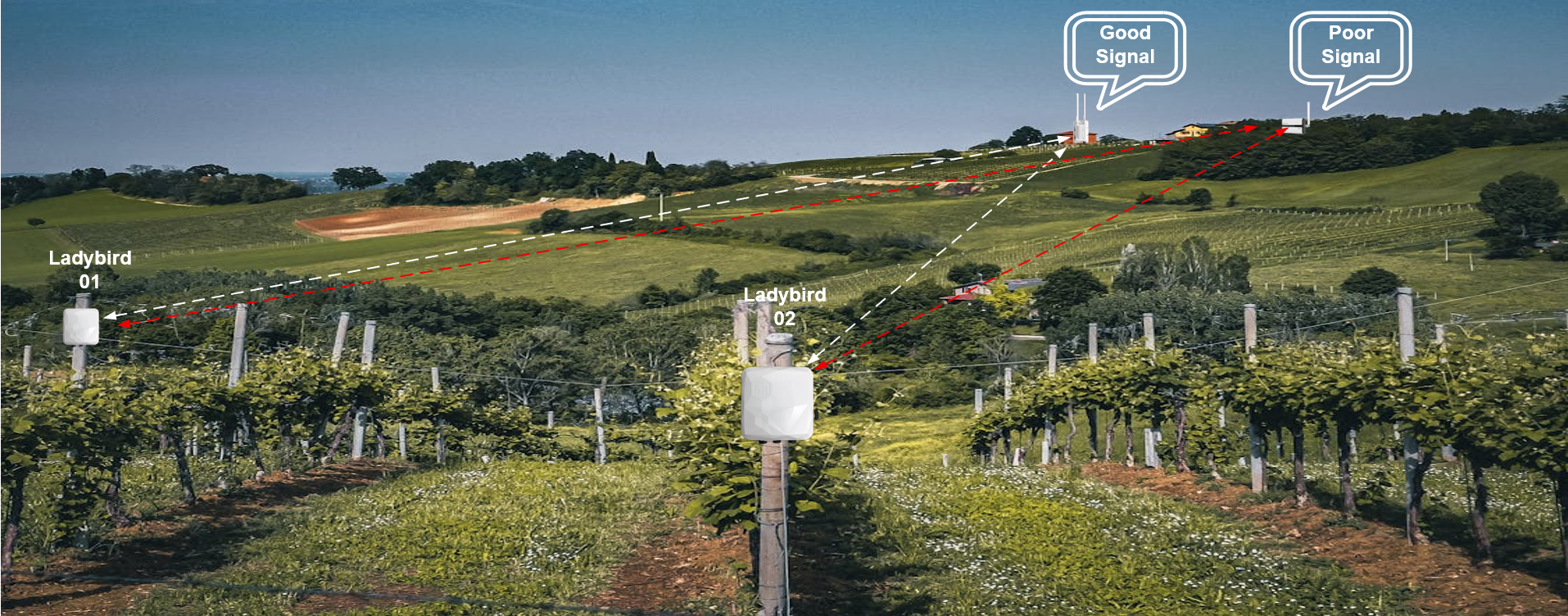
LoRaWAN signals can travel up to 10 km in ideal conditions, typically a high antenna with a clear, flat, open view in all directions. In practice, most real-world installations achieve 1 - 5 km depending on the environment. Take the image below, we have two Milesight gateways, the one on the left is an outdoor gateway, mounted on a pole outside, while the one on the right is mounted inside the building which is located behind the hill and the trees, so poor line of sight.
Every time a radio signal passes through something solid, a wall, a tree line, a hill, it loses strength. Enough obstacles and the signal can't get through at all, even over short distances.
This is why height matters so much. A gateway mounted at 2 metres on a windowsill can only "see" so far before the ground gets in the way. The same gateway on a 6-metre pole can often reach 3–4× further as the signal passes cleanly above hedges, fences, and gentle slopes.
Common Obstacles
|
Obstacle |
Impact |
Solution |
|---|---|---|
|
🏔️ Hills & embankments |
High
|
Raise the gateway height; relocate to higher ground |
|
🌳 Dense tree lines & hedgerows |
Medium–High
|
Mount gateway above tree height where possible |
|
🏚️ Buildings & walls |
Medium
|
Move gateway outside or to an external wall |
|
🌾 Open fields |
None
|
Standard gateway placement will work well |
Choosing the Right Gateway
Not all gateways are equal. The right choice depends on your environment.
Indoor Gateway - UG65
-
Best for indoor deployments
-
Connects via Wi-Fi or ethernet
-
Not weatherproof
-
Works well through 1-2 walls to nearby sensors
-
Not ideal for reaching sensors across open land or over uneven terrain
Outdoor Gateway - UG67 ⭐ Recommended for outdoor use
-
Fully weatherproof (IP67 rated)
-
Designed to be pole-mounted high up
-
Much greater range across fields and uneven terrain
-
Best choice for reaching Ladybird sensors across your land
Gateway Placement Checklist
Use this when deciding where to install your gateway:
-
Mount the gateway as high as safely possible, a roof, barn apex, or dedicated pole is ideal
-
Face the antenna towards the area where most of your sensors are located
-
Avoid pointing the antenna directly at a solid wall, building, or hillside
-
Check for line of sight, can you physically see the sensor location from the gateway position?
-
If a hill or tree line blocks line of sight, consider moving the gateway to higher ground, or adding a second gateway on the far side
-
For very spread-out deployments, two gateways closer to sensors often beats one central gateway
-
Use an outdoor-rated gateway (such as the UG67) for any external installation and consider a solar panel and battery backup for situations where there is limited or intermittent power.
📞 Not sure about your setup? Get in touch and we can advise on the best gateway placement for your specific land and sensor locations.
Ladybird IoT - Helping farms, vineyards, berry growers and rural businesses monitor what matters.